

What is a Query Template Link?
A query template link is a Honeycomb URL with aquery parameter that defines a query specification.
When someone opens a query template link, Honeycomb automatically runs the query and displays the results.
Embedding Honeycomb pages, including query results, within an
iframe isn’t supported.Getting a Query Template Link
The easiest way to create a query template link to build your query in Honeycomb and copy the generated link. To get a query template link:- Select Query () from the navigation menu.
- Build your query in Query Builder, and select Run Query.
- Select Share ().
-
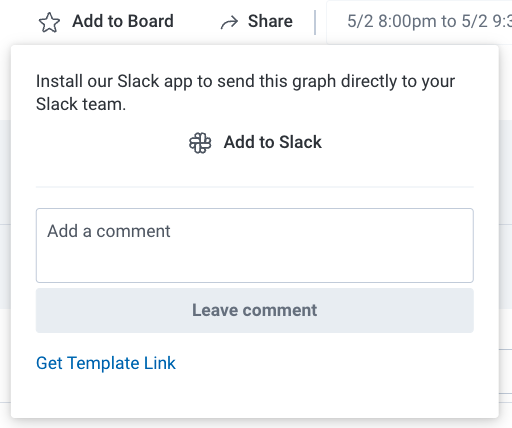
In the modal, select Get Template Link
-
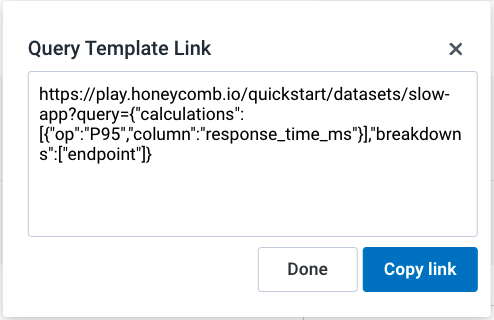
Select Copy link to copy the URL.
Creating a Query Template Link Manually
Construct query template links programmatically by combining a Dataset URL with a JSONquery parameter.
This is useful for generating links from scripts, automation tools, or third-party systems.
URL Format
To create a query template link, construct a URL in this format:query parameter and displays the results.
URL Parameters
Each part of the URL identifies where to run the query and what query to execute:Dataset Context Parameters
team: Slug for the Team in Honeycomb. This short, URL-friendly string uniquely identifies your Team and appears in Honeycomb URLs.environment: Slug for the Environment in Honeycomb. This short, URL-friendly string uniquely identifies your Environment and appears in Honeycomb URLs.dataset: Slug for the Dataset in Honeycomb. This short, URL-friendly string uniquely identifies your Dataset and appears in Honeycomb URLs.
Query Parameters
query: JSON string that defines the query specification. Thequeryparameter value can include calculations, filters, breakdowns, time ranges, and visualization settings. For complete specification details, visit Query Specification.
Examples
This example shows a complete query template link that runs a basicCOUNT query with a filter of duration_ms > 500:
Best Practices
Follow these tips to build useful query template links:- Test your links: Always open query template links in a browser to verify they work as expected before sharing them.
- Use descriptive context: When sharing links in documentation or runbooks, add context about what the query shows (for example, “Check API error rates over the last hour”).
- Keep queries focused: Simpler queries are easier to understand and maintain. Consider multiple focused links instead of one complex query.
- URL-encode when necessary: If your query JSON contains special characters, ensure proper URL encoding to prevent broken links.
- Document your links: If you are embedding query template links in tools or documentation, add comments explaining what each query investigates.
- Version control your links: Store frequently-used query template links in version-controlled runbooks or documentation so your team can track changes over time.
Limitations
Keep these points in mind to ensure your query template links work as expected:- Embedding isn’t supported: Honeycomb pages, including query results, cannot be displayed within an iframe.
- Field availability varies by Dataset: Queries reference specific fields that must exist in the target Dataset. Links may fail if the Dataset doesn’t contain the referenced fields.
- JSON formatting matters: The query parameter must be valid JSON. Syntax errors will prevent the query from running.
- Browser URL length limits: Extremely complex queries may exceed browser URL length limits (typically around 2000 characters). Consider simplifying the query or using the UI to generate the link.