This feature is available as an add-on for the Honeycomb Enterprise plan.
Please contact your Honeycomb account team for details.
Supported Platforms
| Platform | Metrics | Logs | Traces |
|---|---|---|---|
| Kubernetes DaemonSet | ✓ | ||
| OpenShift 4 DaemonSet | ✓ |
Configuration Table
| Field | Default | Description |
|---|---|---|
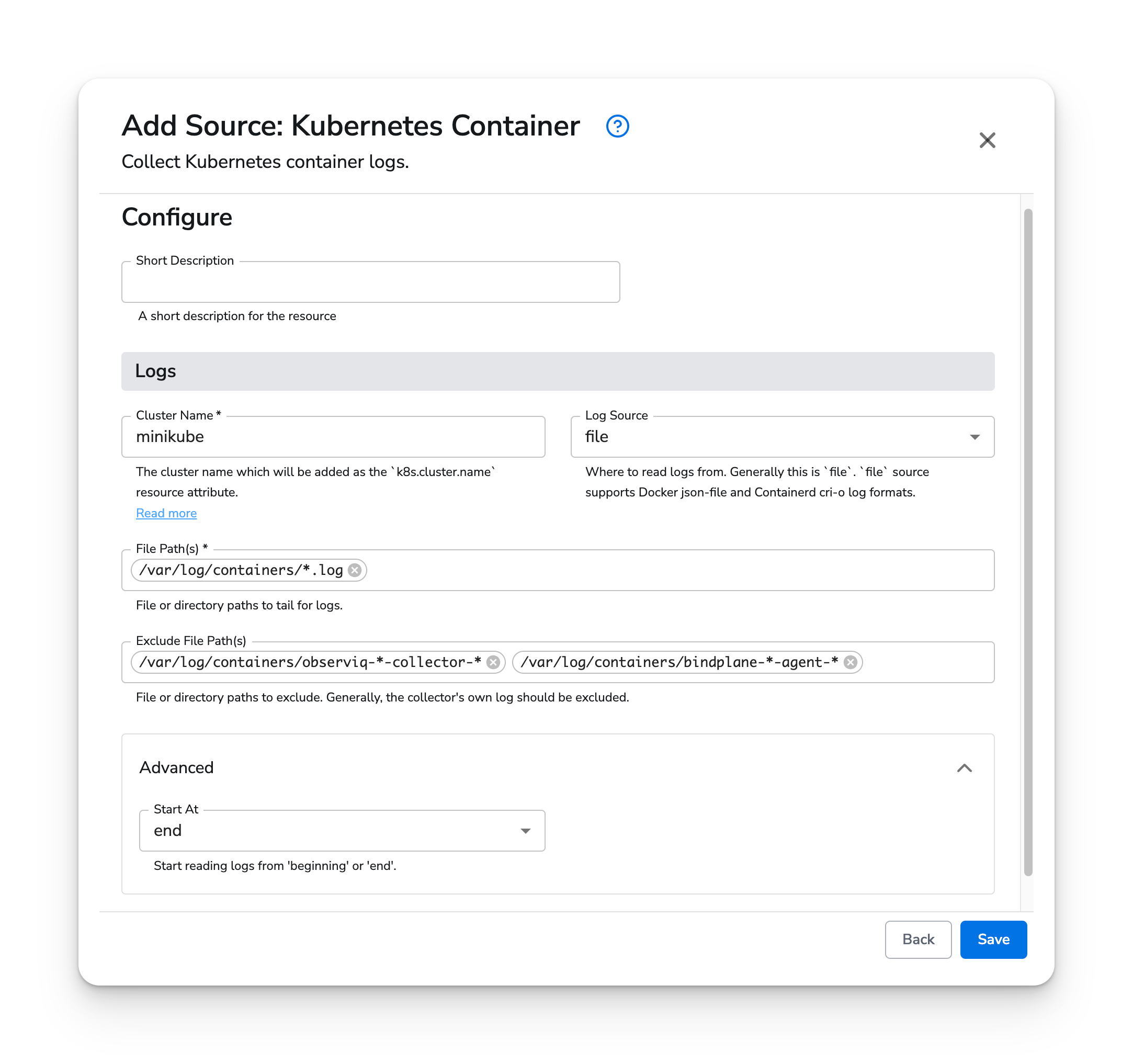
| Cluster Name* | The cluster name that will be added as the k8s.cluster.name resource attribute. | |
| Log Source | File | Where to read logs from. Generally, this is file. file source supports Docker json-file and Containerd cri-o log formats. Options include file and journald. |
| File Path(s) | /var/log/containers/\*.log | When log_source is file. File or directory paths to tail for logs. Defaults to all container logs. |
| Journald Path* | When log_source is journald. The directory containing Journald’s log files. | |
| Exclude File Path | /var/log/containers/bindplane-*-agent-* | File or directory paths to exclude. Generally, the collector’s own log should be excluded. |
| Start At | end | Start reading the logs from the ‘beginning’ or ‘end’. |
| Recombine Logs | Options for configuring multi line logging. See Multi Line Logging. |
Example Configuration
The Kubernetes Container logs source has one required parameter:- Cluster Name: The name of the cluster, which will be inserted as the
k8s.cluster.nameresource attribute
Multi Line Logging
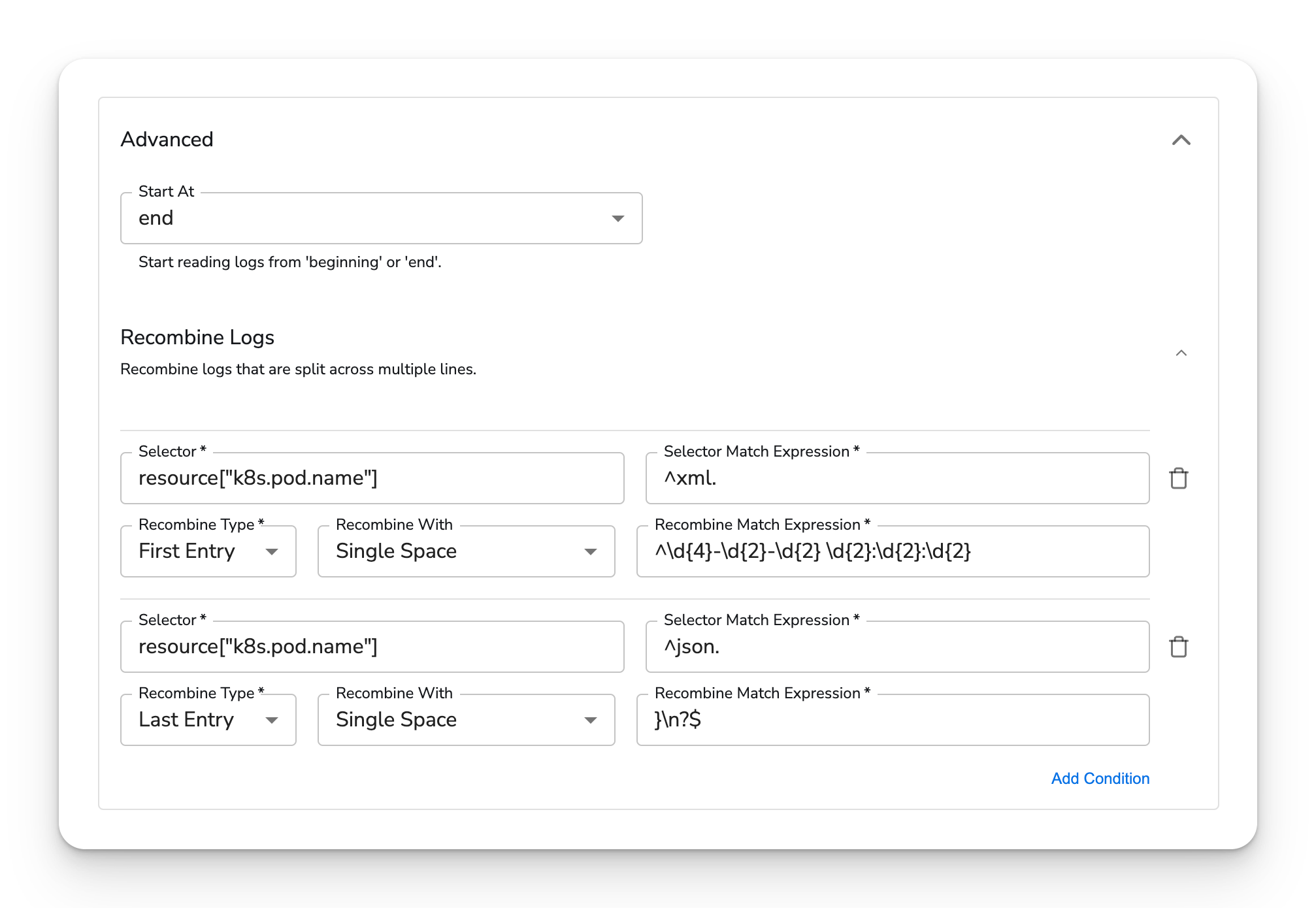
Multi line logging is useful for re-assembling multi line logs into a single log entry. Multi-line log re-assembly requires that all logs emitted by the application are consistent in structure. For example, the logs must start or end in a consistent way, in order to reliably match on the beginning or end of the log. If your application has inconsistent logging, multi-line log re-assembly will behave in irregular ways, such as combining two unique logs into one. Multi line logging is supported by configuring a selector, selector match expression, and a recombine match expression.| Field | Description |
|---|---|
| Selector | The OTTL path to match on. |
| Selector Match Expression | A regular expression used to match the selector. |
| Recombine Type | Whether or not to recombine logs by matching the first or last line in the log. |
| Recombine With | The delimiter used to recombine logs. Defaults a single space or newline character. |
| Recombine Match Expression | The regular expression used to recombine the multi-line log. |
Example
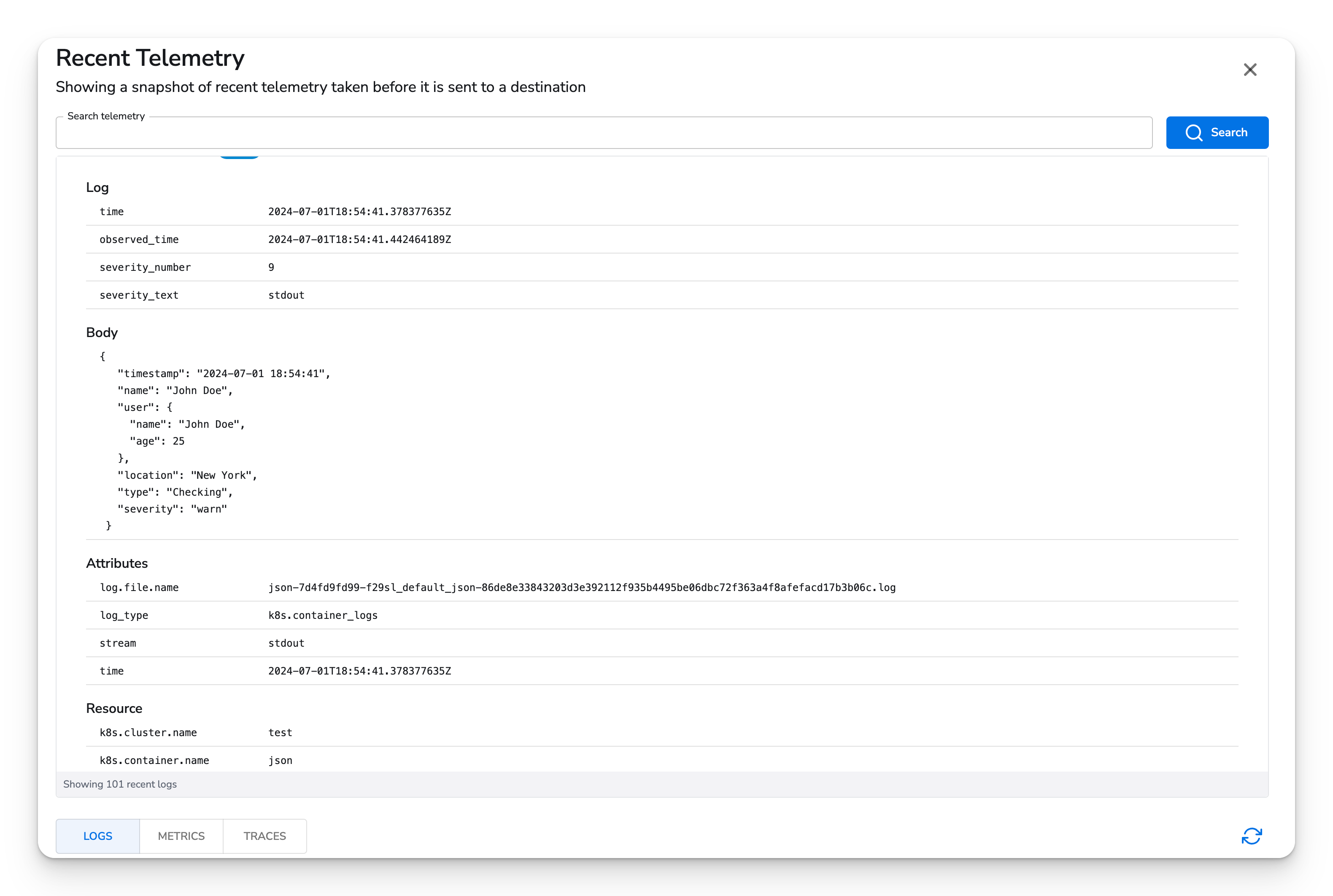
In this example, there are two Deployments. One is logging XML while the other is logging JSON.} without
a comma, indicating the end of the log.
k8s.pod.name resource attribute is used to select the XML and JSON pods.